

Most attempts at a Chinese interior fail in the same way: too many signals. A lattice screen, a carved console, a red lacquer cabinet and a calligraphy scroll in one room adds up to a set of references rather than a style.
New Chinese style does the opposite. It keeps the discipline of Chinese furniture — proportion, restraint, honest joinery — and removes the costume. What remains works in contemporary homes because almost nothing about it looks decorative.
What “New Chinese Style” Actually Means
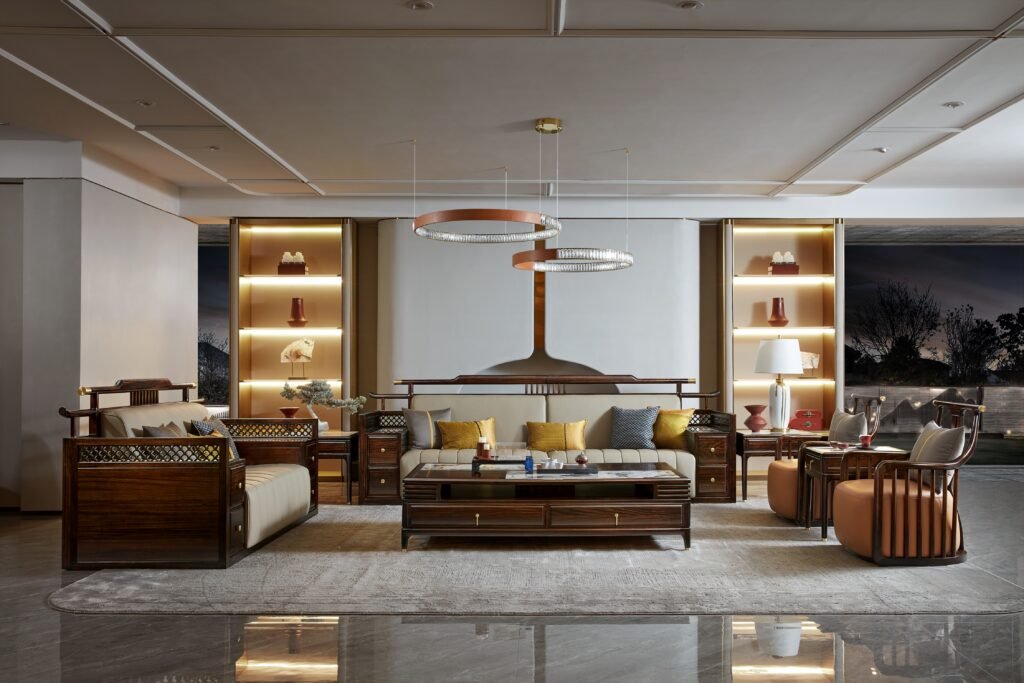
New Chinese style is Chinese structure with contemporary discipline: straight lines, even surfaces, generous negative space, and proportions borrowed from classical furniture rather than ornament copied from it. The wood is solid, the palette is quiet, and the only decoration is the joinery itself.
It sits between two positions. Traditional Chinese furniture is symmetrical, richly detailed and made to be read as an object. Modern minimalism is spare but culturally neutral. New Chinese style keeps the first one’s sense of order and the second one’s refusal of excess.
Five Principles
1. Leave space empty. Chinese interiors were designed around what is not placed in a room. A console on a long wall with nothing above it is closer to the tradition than a gallery wall. Empty space is what makes the proportions legible.
2. Use one material honestly. Solid wood, in one species, finished consistently. Mixing finishes within a room is what makes an interior look assembled rather than designed. A closed-pore finish — even, calm, with a consistent sheen — holds a large room together from every angle.
3. Keep the symmetry, break the formality. Paired elements still matter: two nightstands, two chairs at a desk, a mirror centred above a console. But the pieces themselves should be asymmetric in detail, not in silhouette — a softer arris, a slightly tapered leg, an offset pull.
4. Reduce the reference to one line. A lattice pattern becomes three lines on a cabinet front. A traditional handle becomes a recessed pull. A bracket becomes a shadow gap. One reference per piece, at most.
5. Choose fewer, better pieces. New Chinese style is expensive to do badly and cheap-looking when overfilled. A room with a sofa, a low table, one console and a dining set reads as intentional. The same room with eight objects reads as a showroom.
Room by Room
Living room
A low sofa with a solid frame, a rectangular coffee table with a thin top, and one long console along the wall behind it. The console is the piece that says “Chinese” without ornament — it is a proportion, not a decoration. Keep the floor visible: legs rather than plinths, and no rug reaching the walls.
New Chinese style is most often used in villas and large flats, where the proportions of the collection have room to work — a long dining table, a wide sideboard, a console that needs wall length. In a compact room the same pieces crowd each other, and the restraint that defines the style disappears.
Dining room
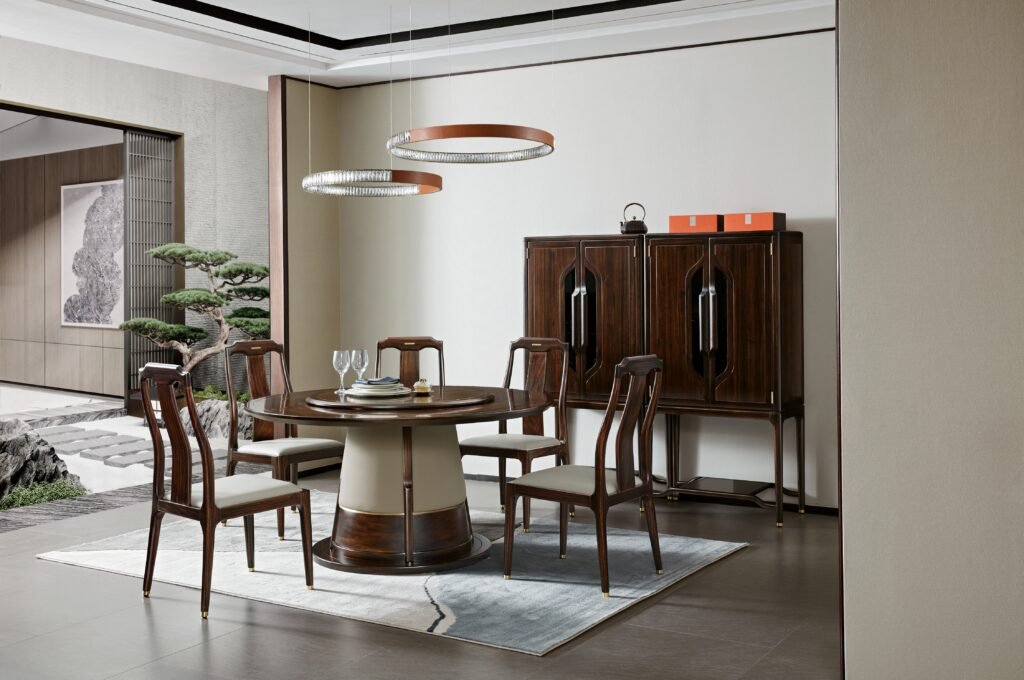
One solid table, four to six chairs, nothing on the walls except perhaps a single horizontal piece. Straight legs, a plain apron, a top thick enough to read as timber. Closed-pore finishes matter here more than anywhere else in the house: dining surfaces take glasses, hot dishes and daily wiping, and a uniform surface stays uniform.
Bedroom
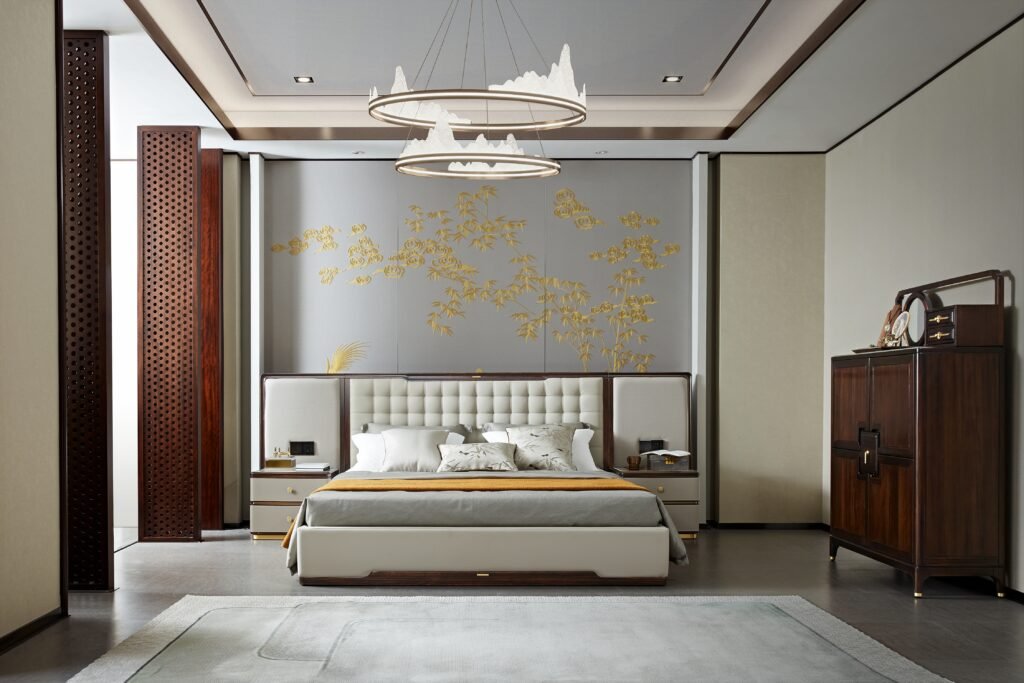
A solid wood bed frame with two matching nightstands is the most common starting point, and the same buyers usually add a wardrobe, a dresser or a writing table from the same collection. Uniform finish does most of the work — the bedroom, the dressing area and the adjoining study are usually visible from one another, and one species in one finish keeps that sight line calm.
Home office
A writing table with a single drawer, a chair with an exposed frame, and a low bookshelf rather than a tall one. The lower the shelving, the more the room reads as a study and less as storage. If the room also serves as a guest room, choose a table deep enough to work at and narrow enough to walk past.
Four Mistakes Worth Avoiding
Stacking symbols. A screen, a lantern, a scroll and a carved chair in one room is costume, not style. Pick one reference and let the rest of the room be quiet.
Darker than the room can carry. Deep reds and heavy browns absorb light. In a north-facing or compact room they close the space down. Walnut reads warm; a red-toned stain reads heavy.
Filling the empty space. The negative space is the design. Resist the urge to add a plant, a side table and a lamp to every corner.
Mixing finishes. Two wood tones, three sheens and a lacquered accent in one room undo the discipline the furniture was chosen for.
How LITAI Interprets It
We build two collections along this line, and the difference between them is a difference in approach, not in level.
New Chinese Style works on proportion: straight legs, clean rectangular frames, thin edges that tighten the whole piece. Its Chinese references are abstracted — a lattice reduced to a few lines, a recessed pull instead of a handle, a shadow gap instead of carving. It is made in ovangkol (Guibourtia ehie, sold in the Chinese market as “African black ebony”) — a dense West African hardwood with dark stripe figure that reads close to black in low light and warm olive-brown in daylight. The finish is closed-pore, so the surface stays even and the room reads composed from any angle, under daylight or interior lighting.
Song Dynasty Aesthetics works on restraint: narrower members, gentler transitions, a silhouette that reads lighter than it is. Here the references are barely signalled at all — exposed joinery, a softened edge, a proportion borrowed from a Song table. It is made in North American black walnut, finished open-pore so the pores stay visible and the timber keeps its texture under your hand, changing colour with the light through the day. It suits a study, a tea room, a reading corner or a holiday house — a quiet room inside a villa or large flat, or a single dedicated room in an ordinary home.
Neither is the more premium choice. One is about order and ease of upkeep; the other is about touch and time.
Buying a Set, or a Single Piece
Every piece can be ordered on its own — there is no minimum quantity for individual buyers — and most buyers start with one room and add to it. We ship worldwide, with shipping calculated for your address and paid by the buyer. If you are planning a whole flat or a villa and want to check that the proportions work together, send us a floor plan and we will tell you which pieces fit — and which do not.
The Short Version
- New Chinese style keeps Chinese proportion and joinery, and removes the ornament.
- One material, one finish, one reference per piece.
- Empty space is part of the design, not a gap to be filled.
- Best suited to villas and large flats, where the proportions have room.
See the New Chinese Style collection, the Song Dynasty collection, or browse by room: living room, dining room, bedroom, home office.
Related reading: Solid Wood vs Veneer: How to Tell the Difference · North American Walnut: Care, Value and Seven Habits · What Is Ovangkol?