

Most furniture listings give you a species name and move on. With ovangkol that is not enough, because the same timber travels under at least four names — and one of the names used in the Chinese market, translated carelessly, points to a completely different wood.
This article sets out what ovangkol actually is, where it grows, how it behaves, how it differs from walnut, and why we build our New Chinese Style collection from it.
Looking Behind the Names
Ovangkol is the commercial name used in Ghana and in most export markets. The same species is sold as shedua in Liberia and as amazique in parts of Central Africa. Botanically there is only one answer: Guibourtia ehie.
In the Chinese furniture trade the timber is commonly called 非洲黑檀 — literally “African black ebony”. That is a trade nickname, not a botanical description, and it causes real confusion in English. “African black ebony” translates to African blackwood, which is Dalbergia melanoxylon — a different species in a different genus, considerably denser, and restricted in international trade. The two are not interchangeable.
If you want certainty in a quotation, ask for the botanical name. Guibourtia ehie is unambiguous.
Where Ovangkol Grows
Ovangkol comes from the tropical forests of West and Central Africa — principally Ghana, Côte d’Ivoire, Nigeria, Cameroon and Gabon. The trees are large, commonly reaching around 30 metres with long clear boles, which matters commercially: wide, straight boards can be produced without excessive joining.
The species is not currently listed in the CITES appendices, which keeps export relatively straightforward. Regulations do change, so buyers should confirm the current status for their own destination rather than rely on a supplier’s assurance.
What the Timber Looks Like
The heartwood runs from pale yellow-brown through olive to a deep chocolate brown, characteristically marked with darker streaks that follow the grain. The pattern is more graphic than walnut’s — bolder lines, stronger contrast. Sapwood is a clearly distinct pale yellow and is normally excluded from visible surfaces.
Grain is usually interlocked. On a quarter-sawn face this produces a ribbon-like figure; on a flat-sawn face it opens into a broad cathedral pattern. Both take a finish well, but they read as different woods, which is why two ovangkol pieces from two workshops can look unrelated at first glance.
How It Performs
Three figures tell most of the story:
- Density around 0.83 g/cm³ — heavy, and solid in the hand in a way board-built furniture is not.
- Janka hardness around 1,330 lbf — harder than black walnut (roughly 1,010 lbf) and comfortably above most furniture hardwoods.
- Moderate workability. Interlocked grain demands sharp tooling; blunt cutters tear rather than slice. This is a machining question rather than a quality question, but it does separate workshops that maintain their tooling from those that do not.
The timber is also notably resistant to insect attack, which is one reason it has a long history in flooring and structural work as well as furniture.
Movement in service is moderate for a hardwood of this density. As with any solid timber, the practical control is drying discipline rather than species choice: our stock is kiln-dried and then acclimatised before assembly.
Ovangkol and Walnut, Side by Side
Both are dark, both are used for high-end furniture, and both appear in our collections — so the comparison is worth making precisely.
| Ovangkol (Guibourtia ehie) | Black walnut (Juglans nigra) | |
|---|---|---|
| Colour | Yellow-brown to olive-chocolate, bold dark streaks | Chocolate to purple-brown, subtler variation |
| Grain | Interlocked, strong ribbon and cathedral figure | Generally straighter, softer figure |
| Hardness | ~1,330 lbf | ~1,010 lbf |
| Weight | Heavier | Lighter |
| Character | Graphic, high contrast | Quiet, low contrast |
| Finish in our ranges | Closed-pore | Open-pore |
The practical difference is temperament. Walnut is a quiet wood: it recedes, and it is forgiving of a room that is already busy. Ovangkol is a graphic wood: the grain is a feature you either design around or design with. It suits pieces with strong outlines and generous flat surfaces, where the figure can be read from across a room.
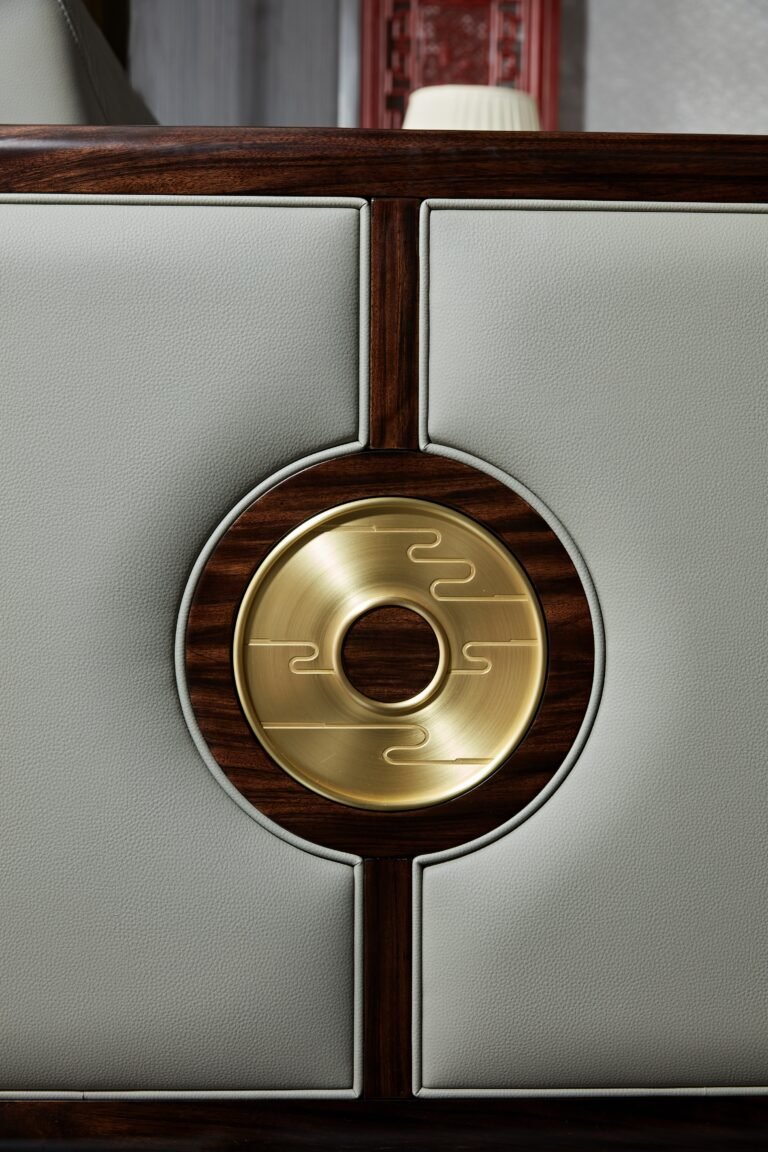
Why We Build Our New Chinese Style in Ovangkol
New Chinese Style furniture depends on proportion and silhouette — restrained outlines, controlled curves, and joints that are meant to be seen rather than hidden. That calls for a timber that holds a crisp edge and reads as dark without reading as black.
Ovangkol does both. Its density holds detail. Its colour sits in the brown range instead of going flat black under low light. And its figure gives large panels something to look at without adding ornament — which is precisely the balance the collection is trying to strike.
We finish these pieces closed-pore. The grain is filled and the surface is smooth to the touch, which stabilises the colour and makes the timber easier to live with in a working room. The trade-off is worth stating plainly: you give up the tactile texture of open grain, and you gain a surface that wipes clean with a damp cloth and does not need oiling.
What Good Finishing Looks Like
If you are assessing a finished ovangkol piece — ours or anyone else’s — four details carry most of the information:
- Filled pores. On a closed-pore surface the grain should read as pattern, not as texture. Run a fingertip across the face; you should feel the figure without feeling open grain.
- Consistent sheen. Patchy sheen means uneven sanding or a thin coat. It will show worse in raking light.
- Colour honesty. Ovangkol varies naturally. Uniform, flat colour across a large panel more often indicates stain than quality.
- Continuous grain at the edges. On solid timber the figure carries from the face onto the edge. On veneer it stops — our guide to solid wood vs veneer covers this in detail.
Buying It: Three Questions
If you are comparing suppliers, three questions settle most of it:
- What is the botanical name? Guibourtia ehie — not “African blackwood”, not “ebony”.
- Is the finish closed-pore or open-pore? They behave differently and need different care.
- Which parts are solid, and which are not? Auxiliary components vary by design. A specific answer is a good sign; “all wood” is not an answer.
Caring for a Closed-Pore Surface
Closed-pore finishes are the low-maintenance option, and the rules are short. (Open-pore surfaces need a different routine — that is covered in our walnut care guide.)
- Wipe with a soft, slightly damp cloth, then dry immediately. Avoid soaking the surface.
- Skip harsh alkaline or acidic cleaners, solvents and abrasive pads.
- Keep the piece out of prolonged direct sunlight. Strong UV shifts the colour of any wood over years.
- Avoid sharp swings in humidity. Solid timber responds to the room; stable rooms make stable furniture.
- No oiling. Closed-pore surfaces are sealed. Adding oil creates a patchy film rather than feeding the wood.
The Short Version
- Ovangkol is Guibourtia ehie, also sold as shedua or amazique.
- In Chinese it is called 非洲黑檀; in English it must not be called African blackwood.
- Dense (around 0.83 g/cm³), hard (around 1,330 lbf), with bold dark-streaked grain.
- We use it for New Chinese Style, finished closed-pore.
- Ask for the botanical name, the finish type, and which parts are solid.
Every piece in the collection can be ordered as a single item — no minimum quantity for individual buyers. We ship worldwide, shipping is paid by the buyer and quoted per order. Send us the piece you are considering and we will confirm the specification for that exact model, including which components are solid ovangkol and which are not.
Related reading: Solid Wood vs Veneer: How to Tell the Difference · North American Walnut: Care, Value and Seven Habits · What Is New Chinese Style?